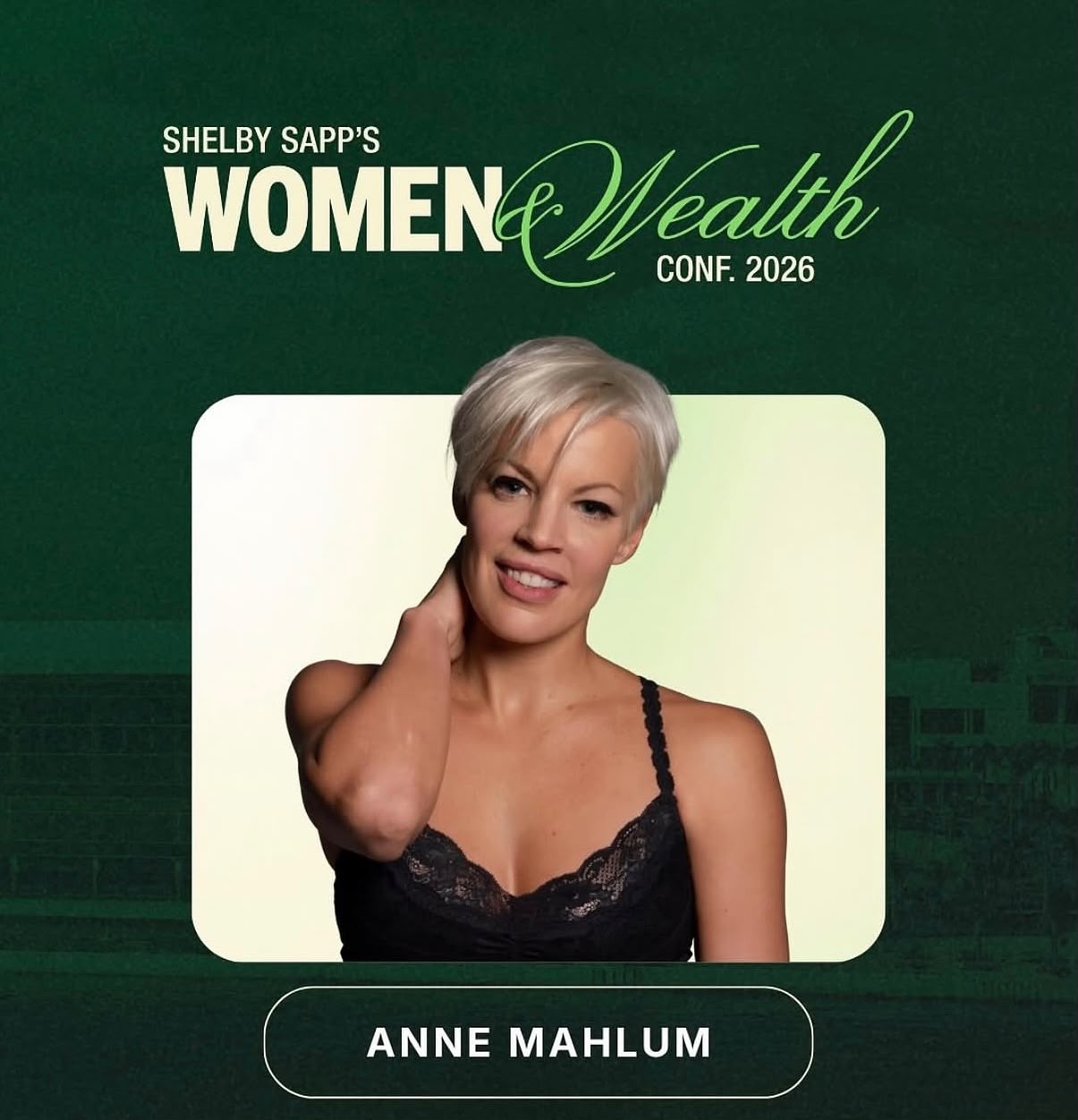
Anne Mahlum asked a question during her Women & Wealth presentation that I think entrepreneurs should ask themselves far more often.
We are incredibly good at imagining everything that could go wrong.
- What if nobody buys?
- What if I lose the money?
- What if I embarrass myself?
- What if I leave the job and regret it?
- What if the business fails?
- What if I am wrong?
Anne offered the opposite question.
What if I'm right?
That question followed her through two completely different organizations.
First, a nonprofit built around running with people experiencing homelessness.
Then Solidcore, a fitness company she ultimately built to 100 locations and sold at a $300 million valuation.
But what made Anne's presentation especially interesting was that she did not stop the story at the exit.
She talked about something we hear much less often at wealth conferences.
Enough.
- Enough money.
- Enough building.
- Enough proving.
- Enough of exchanging the finite hours of our lives for another number we may not actually need.
Her presentation started as a story about entrepreneurship.
By the end, I thought it was really a story about learning how to use ambition without eventually becoming owned by it.
Before Building Wealth, Anne Was Trying to Make Pain Mean Something
Anne grew up in Bismarck, North Dakota.
For much of her childhood, life felt predictable.
- Good family.
- Good grades.
- Sports.
- Friends.
She even kept a box underneath her bed filled with pictures representing the future she assumed was waiting for her.
- The house.
- The career.
- The husband.
- The life.
Then, at 16, she learned that her father had a gambling addiction.
Her parents' marriage ended.
Money suddenly represented something very different.
- Instability.
- Loss.
- Addiction.
- The destruction of the life she thought was guaranteed.
Anne remembers telling her mother that she was going to become somebody and make a lot of money.
At that age, money represented safety.
If money had helped destroy the family, maybe having enough of it could make sure her future looked different.
That belief became fuel.
But as Anne would eventually discover, money alone was never going to answer every question she was asking.
What We Believe Changes What We Notice
Anne spent part of her presentation talking about the stories we tell ourselves.
If I walk into the room believing nobody likes me, the person who fails to say hello becomes evidence.
- See?
- I knew it.
If I walk in believing I belong there and something valuable will happen, I notice different evidence.
- The conversation.
- The introduction.
- The idea.
- The opportunity.
This is a theme that has appeared repeatedly throughout Women & Wealth.
Jasmine Star talked about beliefs.
Sonja Stribling talked about which version of ourselves gets to lead.
Anne approached it slightly differently.
She connected belief to behavior.
Because she had decided she would become somebody, she started behaving like a person trying to create a very different future.
- She completed two college degrees in three years.
- Went to graduate school.
- Moved.
- Took risks.
- Kept searching.
Yet by 24, she was frustrated.
She had achieved some of the things she thought ambitious people were supposed to achieve.
She still had no idea what she was actually supposed to do.
That distinction matters.
Achievement and fulfillment are not the same thing.
Purpose Found Her While She Was Doing Something Ordinary
The only consistent thing in Anne's life at that point was running.
Running had helped her through her parents' divorce.
- It gave her discipline.
- It gave her somewhere to put difficult emotions.
- It made her feel strong.
While living in Philadelphia, she passed a homeless shelter constantly.
For two years, the people outside were simply part of the background.
Then one morning something changed.
She started talking to them.
And eventually asked herself:
Why do I get to be the runner while they have to be the homeless guys?
Running did not care about income.
- Education.
- Housing status.
- Race.
- Background.
It simply asked people to move.
Anne emailed the shelter and proposed starting a running club.
The director essentially told her homeless people had more important things to worry about.
Eventually, he agreed.
Nine men signed up.
And Anne made them sign a contract.
- Show up Monday, Wednesday, and Friday at 6 a.m.
- Be on time.
- Respect your teammates.
- Respect yourself.
I loved what she said about that moment.
She did not lower the standard because the men were homeless.
She expected excellence.
That expectation itself communicated something.
I believe you are capable of meeting it.
Leadership Sometimes Begins With the Standard You Refuse to Lower
This was one of Anne's earliest leadership lessons.
Compassion does not always mean lowering expectations.
Sometimes compassion means refusing to treat people as incapable.
- The men showed up.
- They ran.
- Anne recorded their mileage on a board.
- They wanted to see their progress.
- They wanted recognition.
- They wanted community.
- They wanted to belong.
Eventually Anne realized running was not really the product.
Running was the vehicle.
The deeper product was identity.
- Discipline.
- Community.
- Confidence.
Then employment assistance, education, financial support, and housing resources could be built around it.
That became Back on My Feet.
And Anne was faced with a decision.
She had accepted a corporate job at Comcast.
It represented much of the safe life she once imagined.
Instead, she called the night before she was supposed to start and declined it.
The question became:
What is the worst that happens if I try?
And then:
What is the best that happens if I'm right?
She spent the next six years building Back on My Feet.
She says the organization helped approximately 10,000 people move toward employment and housing.
It worked.
And then another uncomfortable thought appeared.
Maybe she was supposed to leave.
Finding Your Purpose Does Not Mean You Have Found It Forever
I think this may have been one of Anne's most underrated lessons.
We talk about purpose as if we discover one sacred thing and then do it until we die.
Anne had found something extraordinarily meaningful.
- Back on My Feet worked.
- People were being helped.
- She had built an organization.
- There was a team.
- A board.
- A mission.
And still, something inside her said:
It is time to move on.
That created guilt and fear.
- If something is meaningful and successful, why leave?
- What if the next thing is less impressive?
- What if I already peaked?
Anne eventually realized that growth may require us to release something that is still good.
You do not have to wait for something to become terrible before you are allowed to outgrow it.
That applies to businesses.
- Jobs.
- Relationships.
- Roles.
- Entire identities.
Sometimes completing a chapter is not failure.
It is completion.
Fear and Growth Can Feel Almost Identical
Anne described fear in a way I liked.
- Sweaty palms.
- Nervousness.
- Uncertainty.
- The desire to retreat.
But growth can create almost the exact same physical response.
So how do we know whether we are in danger or expanding?
Her point was simple.
If you are not actually being chased by a bear, there is a reasonable chance what feels like fear is growth wearing a disguise.
That does not mean ignore risk.
I am a big believer in understanding downside.
But risk analysis should help us make better decisions.
It should not become a sophisticated excuse for permanent inaction.
Then She Found Solidcore
Anne eventually tried a reformer-style workout in Los Angeles.
Despite being an experienced runner and athlete, it destroyed her.
She loved it.
She also saw a business opportunity.
Women wanted this type of workout.
Nobody had built the kind of national brand around it that she imagined.
So she decided to build one.
She had saved approximately $175,000.
And she put it into the first Solidcore studio.
Shortly before opening, a wealthy friend offered her $75,000 for 30% of the company.
There was no revenue yet.
Keeping some cash aside would have been rational.
Anne turned him down.
Her reasoning was psychological.
If she accepted the money simply because the business might fail, she felt she would be giving herself permission to retreat the moment things became difficult.
And things became difficult.
In her first 15 months, she says she was sued twice and evicted from the first studio.
Yet the business survived.
She Knew the Destination Before She Started Expanding
On the day her first Solidcore studio opened, Anne wrote something to herself.
- She was going to build an empire.
- Open 100 locations.
- And sell the business.
Nine and a half years later, that is essentially what happened.
And the transaction happened approximately two weeks before Solidcore opened location number 100.
What interests me most is not the number.
It is that the destination shaped the decisions years before the exit.
She knew where she wanted to go.
That made it much easier to reject distractions.
Franchising?
No.
Adding bikes and treadmills because existing customers might buy them?
No.
Other opportunities that did not move the company toward 100 locations?
No.
Anne said:
If you're keeping your options open, you're going to tread water for a really long time.
That is probably too absolute for every situation.
Optionality has real value.
But the underlying lesson is excellent.
Every opportunity has a cost.
Usually the cost is attention.
A business can die from too few opportunities. It can also die from too many.
Scale Requires a Repeatable Ecosystem
Anne then shifted into what was probably the best operational material of her presentation.
Ask:
Can this business repeat itself?
Back on My Feet could not scale if everyone had to travel to one running club.
- Each shelter needed its own team.
- Its own members.
- Its own volunteers.
- Its own repeatable structure.
Solidcore worked similarly.
Each studio needed a recognizable operating unit.
- 01Coaches
- 02Management
- 03Processes
- 04Economics
- 05Culture
- 06Standards
If location number 37 requires the founder to reinvent the business, you do not yet have a scalable model.
You have 37 experiments.
Scale comes when the business becomes teachable and repeatable.
Accountability Must Come With Authority
Anne shared another leadership lesson I think every owner should hear.
She once held a manager responsible for performance across several locations.
The manager wanted to remove two employees.
Anne refused.
He challenged her:
You cannot make me accountable for the KPIs while refusing to give me authority over the team responsible for producing them.
He was right.
This happens in companies constantly.
We tell someone: you own the result.
Then we deny her the authority required to produce it.
- She cannot hire.
- Cannot fire.
- Cannot change the process.
- Cannot approve spending.
- Cannot renegotiate the vendor.
- Cannot make meaningful decisions without the founder.
Then we blame her for missing the target.
Responsibility without authority is not delegation. It is theater.
If Only One Person Knows How to Do It, You Have a Problem
Another Anne rule.
If somebody says:
Only Jeff knows how to do that.
Red flag.
Only Lisa understands that system.
Red flag.
Only the founder knows how that decision gets made.
Red flag.
A scalable company needs playbooks.
- Processes.
- Documentation.
- Decision frameworks.
People have to be replaceable.
Including, eventually, the founder.
This connected directly to another principle.
Founder-influenced, not founder-centric.
Anne deliberately avoided making Solidcore entirely about Anne Mahlum.
- She influenced the culture.
- The standards.
- The strategy.
But customers were buying Solidcore.
Not permanent access to Anne.
That becomes extremely important when you eventually want someone else to buy the company.
If the company collapses without you, the buyer is not really purchasing a business.
They are purchasing your employment contract.
Earn the CEO Title Again Every Six Months
Anne said something else I loved.
Your job as CEO should keep changing.
If you are doing exactly what you were doing six months ago, are you actually scaling?
The job should rise with the company.
- 01Customers
- 02Hiring
- 03Operations
- 04Fundraising
- 05Leadership development
- 06Capital allocation
- 07Succession
A founder who refuses to let go of yesterday's responsibilities eventually becomes tomorrow's bottleneck.
The Devil Is in the Deal Terms
Anne also gave unusually practical advice about raising capital.
Do not obsess only over valuation.
Understand the contract.
- 01Control
- 02Governance
- 03Liquidation preferences
- 04Board rights
- 05Exit rights
- 06Who can force what, when, and under which conditions
Get an excellent lawyer.
Anne also said she sold portions of her own equity during earlier investment rounds.
She took approximately $6 million off the table in 2018 and another $9 million in 2021.
That reduced her personal financial pressure before the final sale.
I think that is a sophisticated lesson.
Founders sometimes treat selling any equity before the ultimate exit as lack of belief.
But personal liquidity can improve negotiating power.
If every dollar of your net worth is locked inside the company, a life-changing offer may become very difficult to reject even if it undervalues the business.
Anne had already accumulated meaningful wealth.
So when the eventual buyer came in roughly $10 million below the number she wanted, she could say no.
She did.
And eventually got the number.
Liquidity created patience. Patience created negotiating power.
Build the Business So You Can Leave It
This may have been the most important business lesson of Anne's entire presentation.
Think about your last day at the company.
Long before it arrives.
- Who succeeds you?
- Who knows the relationships?
- Who understands the processes?
- What happens to sales?
- Who owns operations?
- Can the company still function?
If the answer is no, begin fixing that before you decide to sell.
Anne said founders should essentially be working themselves out of a job.
That can sound strange.
We spend years making ourselves indispensable.
Then discover that being indispensable can reduce the value of the thing we built.
A great business should benefit from its founder. It should not require her oxygen to survive.
Then Anne Asked Something Wealth Conferences Rarely Ask: How Much Is Enough?
After making nearly $100 million from Solidcore, Anne could have immediately started another company.
She does not want to.
And her explanation was refreshingly practical.
Another serious company might require another seven to ten years.
- Meetings.
- Calls.
- People problems.
- Fundraising.
- Travel.
- Decisions.
- Stress.
- Thousands upon thousands of hours.
For what?
More money she does not need?
That is a surprisingly difficult question for ambitious people.
We are taught how to increase the number.
Very few people teach us how to decide when the number is sufficient.
At some point, wealth changes the equation.
If invested assets can fund the life you want indefinitely, the scarcest resource is no longer capital.
It is time.
And unlike capital, time does not compound. It disappears.
The Goal of Wealth Should Eventually Be Freedom From Needing More Wealth
I think this may be the idea from Anne's presentation that will stay with me longest.
Building wealth requires ambition.
But wealth should eventually reduce the need for ambition to remain financially motivated.
Otherwise, what happened?
We spent decades creating enough financial freedom that we could choose how to spend our time.
Then continued selling our time because the scoreboard offered another digit.
There is nothing wrong with building another company because you love building.
- Or because the problem matters.
- Or because creation itself is fulfilling.
But that is different from being unable to stop because $100 million somehow made $200 million feel necessary.
Money is supposed to become a tool. Not another addiction.
Have an Identity Outside the Company
Anne ended on a related warning.
If the company is your entire identity, exiting it can create a serious vacuum.
- Who are you without the title?
- Without the employees?
- Without the meetings?
- Without being needed?
- Without the LinkedIn description?
- Without being introduced as founder and CEO?
Those questions deserve answers before the wire transfer arrives.
Anne now talks about investing, her marriage, becoming a mother later in life, sports, travel, and other parts of herself.
Her larger point was that life can contain multiple chapters.
A chapter being successful does not mean we have to stretch it across the entire book.
What I'm taking from Anne Mahlum's presentation
- 01Ask what happens if you're right, not only what happens if you're wrong.
- 02Do not mistake achievement for fulfillment.
- 03Purpose can change. Finding it once does not obligate you to keep the same purpose forever.
- 04Expect excellence from people instead of turning compassion into lowered expectations.
- 05Fear and growth can feel remarkably similar. Learn to distinguish danger from expansion.
- 06Know the destination and work backward from it.
- 07Focus is partly the ability to reject attractive opportunities that do not move you toward the chosen destination.
- 08A scalable business needs a repeatable operating ecosystem.
- 09Give people enough authority to deliver the results for which you hold them accountable.
- 10Document everything important. Only one person knows how is a vulnerability.
- 11Find the bottleneck that prevents your business from scaling and design around it.
- 12Deadlines affect cash flow. Treat operational timing as an economic issue, not merely a project-management issue.
- 13Your job as CEO should evolve as the company evolves.
- 14Build a founder-influenced business, not a founder-dependent one.
- 15Understand deal terms, control, and governance, not just valuation.
- 16Personal liquidity can create negotiating strength rather than signaling lack of belief.
- 17Plan succession before you think you need succession.
- 18Build the company so it can eventually operate without you.
- 19Know your number. More wealth does not automatically mean a better life.
- 20Protect an identity outside your business so success does not trap you inside the thing you created.
What If You're Right?
There is an interesting symmetry in Anne's story.
At 26, she had to believe she might be right about running with people experiencing homelessness.
At 32, she had to believe she might be right about a fitness concept nobody had built quite the way she imagined.
Years later, she had to believe she might be right about what Solidcore was worth.
And after the exit, she had to believe she might be right that she did not need to build another company.
We usually associate courage with beginning.
Courage is starting.
Sometimes courage is leaving.
Courage is taking the money.
Sometimes it is saying no to the investor.
Courage is seizing the opportunity.
Sometimes it is ignoring another one.
Courage is closing the deal.
Sometimes it is holding out for your valuation.
Courage is being indispensable.
Sometimes it is accepting the company can survive without you.
Courage is building the next thing.
Sometimes it is deciding you already have enough and would rather keep the remaining years.
That is what made Anne's presentation such a fitting talk for Women & Wealth.
Because wealth is not simply learning how to make money.
It is learning how to build assets that eventually separate income from your time.
- It is learning how to protect ownership.
- Learning when to sell.
- Learning how to invest afterward.
And finally learning that the entire purpose of the exercise was to create more choices.
Not another cage.
This Is Part Six
This is Part Six of my Women & Wealth conference series.
The speakers so far have approached wealth from completely different directions.
- Sales.
- Identity.
- Product creation.
- Digital leverage.
- Personal transformation.
- And now scale, ownership, exits, and enough.
Anne Mahlum left me with two questions.
The first is for anyone still hesitating to begin:
What if you're right?
The second may be even more important once the building actually works:
What is all this money ultimately supposed to allow you to stop doing?
Because if we never answer the second question, there is a real possibility we will spend our entire lives accumulating freedom without ever actually using it.
Topics
- Women & Wealth
- Scaling
- Business Exit
- Ownership
- Anne Mahlum
Naihomy Navarro
Faith. Discipline. Elevation.
I write from Santo Domingo about building with intention: business, wealth, identity, and the decisions that hold everything else up.
Let's build something that lasts
If these ideas resonate, let's talk about collaborations and partnerships.
Connect