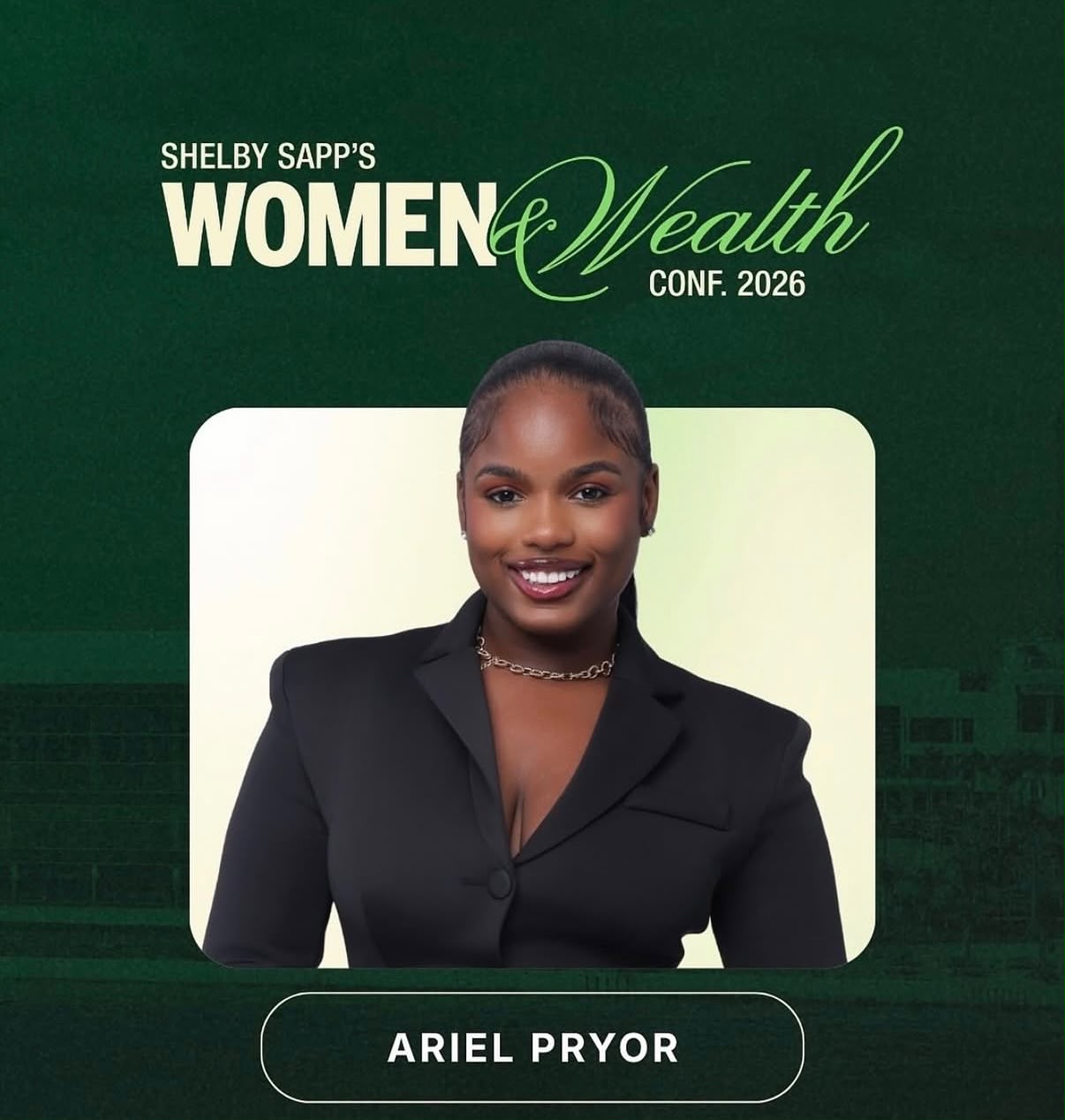
When Ariel Pryor walked onto the Women & Wealth stage, the introduction sounded like the end of a very successful story.
- Twenty-two years old.
- Seven-figure business owner.
- Millions of followers.
- Millions of dollars in sales.
- First homeowner in her family at 20.
- First millionaire in her family by 21.
Those are the numbers people put in introductions.
Ariel's point was that introductions usually begin at the wrong part.
They tell us where someone arrived.
They rarely tell us what she had to survive, learn, change, abandon, repeat, or build before anyone thought she was worth introducing.
Ariel wanted to talk about that version of herself instead.
The girl from the South Side of Chicago who simply wanted to make it.
And somewhere between her story of growing up without heat and hot water and her breakdown of selling $10 digital products online, I realized her presentation was really about one thing:
How do you create leverage when the life you were given does not contain much leverage at all?
Before the Millionaire Was a Girl Trying to Find Stability
Ariel described growing up in a crowded two-bedroom home in Chicago.
At times there was no heat or hot water.
Plastic bags were taped over windows during Chicago winters.
Water had to be boiled for bathing.
Evictions happened so frequently that instability started to feel normal.
She said something that stayed with me.
She did not have examples of what she wanted life to look like.
She had examples of what she did not want it to look like.
That is a different kind of motivation.
At ten years old, Ariel remembers sitting on an enclosed back porch crying and asking why her life could not feel normal.
Then she made an extraordinarily specific declaration.
She would become a millionaire before she turned 21.
There was nothing in her environment that made that outcome appear obvious.
But whether we interpret that declaration through faith, ambition, survival instinct, or some combination of all three, what matters is what came next.
She started moving.
Sometimes the First Lesson Is Simply Staying
Ariel joined a dance team.
She was not good.
The older girls laughed at her.
She got into arguments.
She was suspended and kicked off.
And she kept coming back.
That became one of the most useful ideas in her presentation:
You have to stay somewhere long enough to get good.
We live in an era where starting is celebrated constantly.
- Start the business.
- Start creating.
- Start investing.
- Start posting.
- Start selling.
Starting matters.
But staying is where competence usually develops.
Ariel knew she was bad at dancing.
What she did not conclude was that being bad at the beginning meant she was incapable of becoming good.
Those are completely different statements.
I am bad at this.
I am bad at this right now.
This is not for me.
I have not stayed long enough to find out.
They are better than me.
They started before me.
I should have the identity already.
I am in the apprenticeship.
She improved.
She became captain.
She began training other dancers.
Her coach, who had initially been frustrated by her behavior, became a father figure who saw that underneath the difficult child was someone looking for direction and belonging.
There is a broader lesson here for entrepreneurship.
A business can be bad before it becomes good.
- Your content can be bad.
- Your sales pitch can be bad.
- Your product can need work.
- You can enter an industry knowing far less than the people around you.
The question is whether you are willing to survive the stage where your ambition is larger than your ability.
Most people want the identity immediately.
Few people enjoy the apprenticeship.
Try Enough Things to Discover Where Your Advantage Is
Ariel started working extremely young.
- She worked in a home daycare.
- She sold sunglasses.
- Headbands.
- Do-rags.
- Eventually she began doing hair.
None of those things individually represented the final business she would build.
But each one taught her something.
- How to sell.
- How to deal with customers.
- How to promote herself.
- How to reinvest.
- How to recognize demand.
- How to make money independently.
And, perhaps more importantly, how to keep trying things.
Ariel said something simple that entrepreneurs sometimes forget:
If you do not try things, you will never know what you are good at.
Not every business idea needs to become your business.
Not every experiment deserves another five years.
Sometimes the purpose of one opportunity is to teach you enough to recognize the next one.
The danger is expecting the first vehicle you enter to be the one that takes you all the way to the destination.
Being Seen Is Not the Same as Being Supported
By 14, Ariel was promoting her hairstyling aggressively on social media.
Sometimes she only had two clients.
She posted those same two clients again and again anyway.
Then one day her work went viral.
She initially thought this was the breakthrough.
Instead, people from her hometown were sharing the post to criticize her.
The comments were cruel.
Her takeaway was sharp:
You will often have more views than likes. Being seen does not mean being supported.
That is worth remembering in a world where we measure ourselves publicly.
- People can watch without cheering.
- They can consume without engaging.
- They can criticize something they could never create themselves.
- They can follow the story quietly for years and only acknowledge it after the outcome becomes undeniable.
Ariel kept building anyway.
That seems simple when written here.
It is much harder when your work, appearance, intelligence, or ambition is being publicly mocked.
Visibility requires emotional stamina.
Especially before visibility becomes validation.
Her Income Changed When She Stopped Doing Everything
At 16, Ariel was still doing hair.
Like many early entrepreneurs, she thought the way to make more money was to offer more things.
- If someone wanted a bob, she would do it.
- A ponytail? Yes.
- Color? Yes.
- Almost anything a customer requested became another service.
Then she simplified.
She reduced the business to one or two core services priced around $200 to $250.
Her income changed dramatically.
She says she made her first $100,000 at 16.
That is an unusually large result for a teenager, but the principle applies much more broadly:
Revenue does not always increase when the menu gets bigger.
Sometimes the opposite happens.
- More offers can mean more complexity.
- More inventory.
- More training.
- More customer confusion.
- More operational variation.
- More ways for quality to break.
- More things to market.
Ariel doubled down on what was working.
The business became easier to understand and each appointment became more valuable.
This reminded me of something Lori Greiner discussed in the previous presentation.
If customers cannot quickly understand what you do, you have created another problem for yourself.
Focus is not only operational.
It is marketing.
$200,000 in Income Still Did Not Equal Freedom
The following year, Ariel says she generated roughly $200,000 doing hair.
That should have felt like success.
Instead, she discovered another ceiling.
To earn more, she had to physically do more.
- More appointments.
- More hours standing.
- More clients.
- More strain on her body.
She said it perfectly:
Income is not the same as leverage.
That may be one of the most important financial ideas from her entire presentation.
High income can still be completely dependent on your time.
- A lawyer can make $500,000 and still have to perform the work.
- A doctor can earn $800,000 and still be constrained by hours.
- A consultant can have an incredible year while remaining the only person capable of delivering the service.
- A hairstylist can make exceptional money while every dollar still requires another head of hair.
There is nothing wrong with earning through labor.
The question is what happens if you want to grow beyond your own available hours.
Eventually you need leverage.
- People.
- Technology.
- Capital.
- Media.
- Intellectual property.
- Systems.
- Products.
- Distribution.
Something must allow value to move beyond the number of hours you personally possess.
Ownership Does Not Automatically Create Freedom Either
By 18, Ariel owned a salon.
For someone who grew up experiencing repeated eviction, possessing the key to her own business carried obvious meaning.
But she quickly discovered another uncomfortable truth.
Owning something does not necessarily mean it can operate without you.
The salon was hers.
The bills were hers too.
If she wanted to keep paying them, she still needed customers.
She still needed to do hair.
The business had changed ownership.
The economic model had not changed enough.
I make good money.
Does the money still require my hours?
I own the business.
Can the business run without me in it?
I need more clients.
I need a way to serve more people at once.
I should add another service.
I should package what I already know.
That forced Ariel to ask what may have been the most important business question in her presentation:
How can I help more people with what I already know?
That question changed everything.
Your Next Product May Already Be Inside Your Current Skill
Ariel did not go back to school to acquire an entirely new profession.
She looked at what she already knew.
- She knew how to do hair.
- She knew how to build clientele.
- She knew how to promote herself.
- She had built a salon.
Other women wanted to learn those things.
So she packaged the information into an ebook.
Price: $47.
- No inventory.
- No shipping.
- No appointment.
- No customer sitting in a chair.
- No requirement for Ariel to be physically present when the transaction happened.
Someone could buy while she slept.
That first digital product generated $24,104 according to Ariel.
The money mattered.
But what really excited her was the mechanism.
For the first time, she saw a path where the next dollar did not automatically require another hour of physical labor.
She had found leverage.
There Was a Process Behind the Profit
This is where Ariel made an important clarification.
She did not upload an ebook once and wake up rich.
- She promoted it relentlessly.
- She talked about it repeatedly.
- She shared testimonials.
- She posted results.
- She listened to customer complaints.
When buyers said the guide was too short, she added more material.
She experimented with pricing.
She kept putting the product in front of people.
Her phrase was:
There was a process behind the profit.
I think this deserves more attention.
The internet has made digital products look deceptively easy.
- Create a PDF.
- Upload it.
- Add a Stripe link.
- Make passive income.
Technically, yes.
Commercially, not necessarily.
A digital product eliminates many fulfillment constraints.
It does not eliminate the need for demand.
- Someone still has to know it exists.
- Someone has to trust you.
- Someone has to understand the value.
- Someone has to believe the problem is important enough to spend money solving.
Passive fulfillment is not passive marketing.
Ariel's product sold because she was willing to remain extremely active in creating demand.
You Already Have Something to Sell
Ariel's low-ticket framework was one of the most tactical parts of the conference so far.
Her premise is that many people already possess knowledge someone else values.
The person does not necessarily need another degree or an entirely new skill.
She may need to package what she already knows.
- A salesperson could teach objection handling.
- A hairstylist could teach technique.
- A fitness professional could create a beginner program.
- A business owner could create a startup guide.
- A social-media manager could sell templates.
- A parent could package a system she developed.
The key is that the product should create a specific useful outcome for a specific person.
That last part matters.
I know a lot about business.
How to start your first home-based hair business.
I help people get healthy.
A four-week beginner plan for women who have never lifted.
I teach marketing.
The exact captions I use to sell a $27 offer.
The tighter the problem, the easier the product becomes to understand.
Why Ariel Loves Low-Ticket Products
Ariel built much of her early digital business around relatively inexpensive products.
Her framework generally places low-ticket offers between about $7 and $97.
Her reasoning is straightforward.
- At that price, the customer perceives relatively little risk.
- The buying decision is simpler.
- No sales call may be necessary.
- The customer can receive an immediate result.
- The seller can acquire a buyer who may later purchase something much more expensive.
There is real business logic here.
A $27 customer is fundamentally different from a follower.
One has demonstrated willingness to transact.
That creates an opportunity to build trust and eventually offer something larger.
Social Media Is the Storefront
Ariel sees social media very differently from people who treat posting as an optional branding activity.
For her, social media is distribution.
She reported receiving more than 92 million views over a 90-day period.
Her logic is simple.
- Every Reel.
- Every Story.
- Every post.
- Every piece of content.
Each is another opportunity for someone to discover the business.
If your business depends on attention, visibility is not vanity.
It is infrastructure.
And Ariel gave the audience an extremely simple three-part framework for deciding what to post.
- 01Trust content. Show people that you know what you are talking about. Teach, share results, show testimonials, explain your process, let people see behind the scenes. It answers the question: why should I listen to you?
- 02Community content. Invite people into the conversation. Ask questions, run polls, respond to comments, share customers, create language people identify with. This shifts social media from broadcasting to belonging.
- 03Controversy content. Express opinions strong enough to create conversation. Challenge a normal assumption, offer an unpopular perspective, say something people can agree or disagree with.
On Trust Content
One point Ariel made here was particularly good.
People do not always need perfection.
In fact, perfection can sometimes make connection harder.
The polished result establishes credibility.
The imperfect process establishes relatability.
A strong brand can show both.
On Community Content
Community content lets the audience participate rather than simply watch.
People are not only consuming the content.
They begin seeing themselves as part of the world surrounding it.
That can become extremely powerful commercially, because humans buy inside communities all the time.
On Controversy Content
This was Ariel's favorite.
Not outrage for the sake of outrage.
Not saying something offensive because attention is valuable.
Content that creates an emotional reaction tends to travel further than content everybody quietly thinks is fine.
What Ariel's Presentation Really Taught Me
Ariel's story contained extraordinary circumstances.
Most people will not earn $100,000 at 16.
Most will not become millionaires by 21.
That should not be the standard we use to determine whether her lessons matter.
The useful part is the sequence.
- 01She tried enough things to find where her advantage was.
- 02She stayed long enough to get good.
- 03She specialized once she knew what was working.
- 04She raised the value of her time.
- 05She recognized the ceiling of selling only her labor.
- 06She packaged what she already knew into a product.
- 07She used media as distribution rather than decoration.
- 08She listened to buyers and improved the product.
- 09She repeated what worked.
That sequence is available to far more people than the headline numbers might suggest.
What I'm Taking From Ariel Pryor's Presentation
- 01Do not let your starting environment define the size of your ambition.
- 02Stay somewhere long enough to become competent before deciding you are incapable.
- 03Try enough things to discover your strengths, but do not confuse experimentation with permanent lack of focus.
- 04Being watched is not the same as being supported. Build anyway.
- 05Simplification can increase revenue. More offers do not automatically mean more money.
- 06Income and leverage are different. Eventually ask what can create value without requiring another hour from you.
- 07Ownership alone is not freedom. Understand how dependent the business remains on your personal labor.
- 08Ask: how can I help more people with what I already know?
- 09Package knowledge around a specific customer and a specific problem.
- 10Passive fulfillment still requires active demand creation.
- 11Listen after the sale. Customers will tell you where the product needs to improve.
- 12Treat social media as distribution, not decoration.
- 13Create trust, community, and conversation instead of endlessly posting advertisements.
- 14Use controversy carefully. Attention should strengthen the business rather than become the business.
- 15Remember that the process behind the result is usually more useful than the result itself.
Your Current Situation Is Not Your Final Destination
Ariel titled her presentation around that idea.
After hearing her story, I understand why.
Her childhood circumstances were real.
So were the losses she experienced.
So was the criticism.
So was the lack of stability.
None of it needed to be minimized for her to believe something else could eventually be built.
That may be the balance I appreciated most.
We do not have to pretend the current situation is good.
We simply do not have to treat it as permanent.
- The salon can be successful and still not be the final business model.
- The skill that pays today can become the knowledge product tomorrow.
- The two clients you keep posting can eventually become hundreds.
- The first imperfect product can teach you how to build the next one.
The thing that looks like the destination today may simply be the vehicle that gets you closer.
Ariel's introduction told us where she arrived.
Her presentation showed us something more useful.
How she kept moving.
Looking across the complete Women & Wealth series, that may be one of the themes connecting almost every speaker.
The women on the stage did not begin as the women being introduced.
They became them.
This Is Part Four
This is Part Four of my Women & Wealth conference series.
I am continuing to work through each presentation not simply to repeat what was said, but to identify what is genuinely useful, where I think an idea needs more context, and what I can actually apply after the conference ends.
Ariel Pryor's presentation left me with one question I think almost every entrepreneur should answer:
What do I already know how to do that could help more people than I can personally serve today?
There may be far more leverage inside that answer than we realize.
Topics
- Women & Wealth
- Digital Products
- Leverage
- Social Media
- Ariel Pryor
Naihomy Navarro
Faith. Discipline. Elevation.
I write from Santo Domingo about building with intention: business, wealth, identity, and the decisions that hold everything else up.
Let's build something that lasts
If these ideas resonate, let's talk about collaborations and partnerships.
Connect