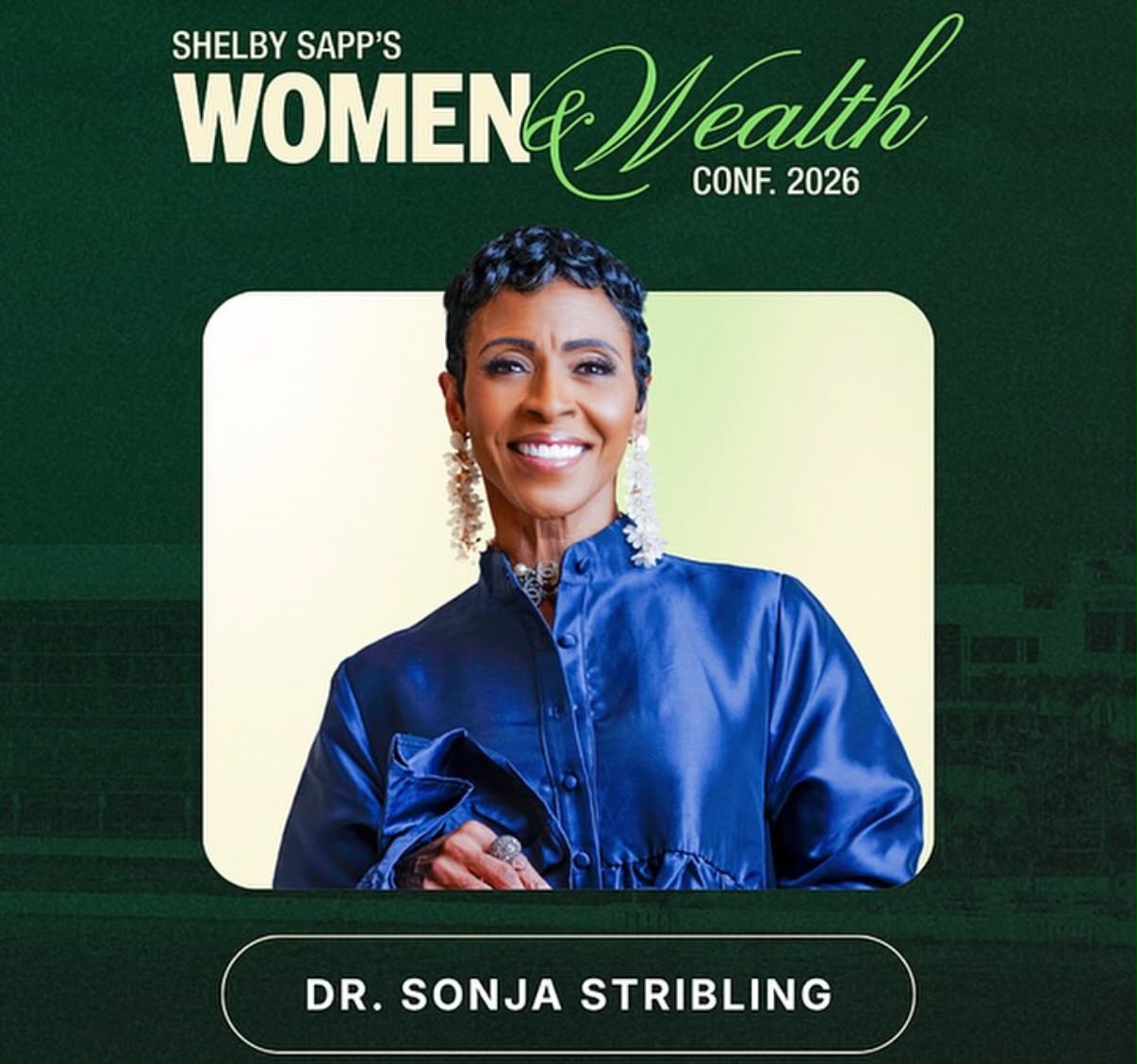
There was a sentence Dr. Sonja Stribling repeated during her Women & Wealth presentation that could almost stand alone as the entire message.
If you didn't come from a wealthy family, allow a wealthy family to come from you.
I wrote that one down.
Because it changes the way we think about generational wealth.
We spend a lot of time discussing what people inherit.
- Money.
- Property.
- Connections.
- Education.
- Businesses.
- Financial literacy.
- Access.
And those advantages absolutely matter.
But someone had to become the first person in every wealthy family.
- Someone eventually bought the first investment property.
- Started the company.
- Learned how to invest.
- Changed how the family talked about money.
- Built the relationships.
- Created the estate plan.
- Accumulated the assets.
- Passed something forward that had not been passed to them.
Sonja's presentation was about becoming that person.
She called the process Design Her.
And while there was plenty of motivation in the room, her underlying argument was more demanding than motivational:
The future version of you cannot remain an accidental outcome. She has to become an intentional design.
Vision Without Design Is Only a Dream
Sonja referenced Helen Keller's famous statement about having sight without vision.
Then she added her own.
Vision without design is only a dream.
That distinction matters.
Most ambitious people have visions.
- The business.
- The money.
- The house.
- The freedom.
- The family.
- The lifestyle.
- The impact.
- The investment portfolio.
The problem is that visualization can sometimes create the emotional satisfaction of progress without requiring actual progress.
We imagine the destination so vividly that the imagining starts feeling like work.
Sonja's challenge was different.
- What exactly are you designing?
- Who does that future require you to become?
- What decisions does she make?
- What rooms does she enter?
- What does she sell?
- What does she stop tolerating?
- What does she stop asking permission to do?
And perhaps most importantly:
Which version of you gets to make those decisions?
The Person Being Introduced Is Rarely the Whole Story
Like several other speakers at Women & Wealth, Sonja deliberately interrupted the polished version of success.
She talked about building a company she says generated $28 million.
She has spoken on major stages.
She has written books.
She coaches entrepreneurs.
Those are the credentials people normally lead with.
Instead, she talked about the versions of herself that existed before them.
- Becoming a mother at 14.
- Surviving sexual violence at 17.
- Serving more than two decades in the United States Army, including combat tours.
- Struggling mentally after coming home.
- Going through divorce and bankruptcy.
- Reaching a point where she contemplated taking her own life.
She described a woman whose physical body had returned from military service while another part of her had not.
That history matters to the rest of her framework because Design Her was not about pretending those earlier versions never existed.
It was about deciding whether they should continue leading.
Which Version of You Is Making Today's Decisions?
This may have been the most visually effective part of Sonja's presentation.
She brought several women onto the stage.
Each represented a different version of Sonja.
- The young mother.
- The traumatized woman.
- The medicated version.
- The divorced version.
- The military version.
Then she physically demonstrated what happens when an old version of ourselves leads us toward a new destination.
We say we want wealth
But fear leads
We say we want the company
But the version who believes she is unqualified leads
We say we want a healthy relationship
But the version who no longer trusts anyone leads
We say we want to invest
But the version who once lost everything controls every financial decision
We say we want visibility
But the child who learned that attention was dangerous keeps us hidden
Sonja's point was not that our past should be erased.
Some of those versions protected us.
Some survived things the current version may barely understand.
Some developed extraordinary strengths.
Her military identity, for example, was one she chose to carry forward because of the discipline and resilience it gave her.
The work is deciding what comes with us.
Your past can inform the future without being allowed to govern it.
That distinction is powerful.
Identify Who You Are Right Now
One of Sonja's first principles was deceptively simple.
Identify who you are right now.
- Not who Instagram thinks you are.
- Not your job title.
- Not the company.
- Not somebody's wife.
- Not somebody's mother.
- Not the person your parents expected.
- Not who an old relationship told you that you were.
Who are you?
This connects beautifully with Jasmine Star's presentation earlier in the conference.
Jasmine asked: who do I need to become before I build?
Sonja added: who is currently doing the building?
Those questions belong together.
You cannot intentionally design the next version without getting honest about the current one.
Stop Asking for Permission
Sonja deliberately had women leave their seats and move toward the stage.
It created chaos.
That was the point.
She wanted women to physically experience moving before someone officially invited them.
Her message became simple.
Go get what you want.
Then came one of her best lines.
Validation is for parking tickets only.
I laughed.
And wrote it down.
Because many intelligent, capable people spend years waiting for an invisible authority to certify that they are finally allowed to begin.
- Permission to start the business.
- Permission to raise the price.
- Permission to publish.
- Permission to leave.
- Permission to invest.
- Permission to enter a different industry.
- Permission to call themselves an expert.
- Permission to become wealthy.
At some point, we authorize ourselves.
Get Into Rooms Your Current Level Cannot Create
Another of Sonja's principles was about proximity.
Get in the rooms your current level cannot create.
That was especially appropriate at Women & Wealth.
Conferences can easily become expensive entertainment.
- You listen.
- Take pictures.
- Exchange Instagram handles.
- Collect business cards.
- Return home.
- Nothing changes.
Then there are rooms that actually compress distance.
Someone sitting beside you may already know the person you need.
A speaker may solve a problem you have spent six months trying to understand.
A five-minute conversation may expose a business model you did not know existed.
A relationship may lead to a customer, partner, employee, investor, advisor, or simply a different way of thinking.
Never Let Comfort Cost You Your Calling
Sonja's next principle was about comfort.
And I think this is where entrepreneurship becomes uncomfortable almost by definition.
Growth repeatedly asks us to exchange something known for something uncertain.
A known salary
A business
A familiar market
A bigger one
A comfortable price
The possibility of rejection
A small team we control personally
A larger organization requiring delegation
An audience that already likes us
A new audience that has never heard of us
Comfort has value.
There is nothing inherently virtuous about making life unnecessarily difficult.
But comfort becomes expensive when maintaining it requires us to keep rejecting opportunities we genuinely want.
The question is not: am I comfortable?
It is: what is this comfort costing me?
Mind Your Business
Sonja eventually jumped to another principle that sounded almost comically simple.
Mind your business.
Not only the company.
- Your business.
- Your direction.
- Your work.
- Your clients.
- Your growth.
- Your reputation.
- Your execution.
She argued that entrepreneurs waste enormous amounts of attention watching competitors and talking about everybody else.
I agree.
The Four Personality Types
Sonja also introduced four personality categories she uses when thinking about people and sales.
- Urchins: analytical, detail-oriented, methodical.
- Dolphins: energetic and fun-oriented.
- Whales: service-driven and motivated by helping others.
- Sharks: decisive, fast-moving action takers.
The point was practical.
Different people respond to different information.
- One customer wants the spreadsheet.
- Another wants the experience.
- Another wants to understand the impact.
- Another wants to know the destination and begin immediately.
That basic sales lesson is valuable.
Stop selling to everyone as though everyone thinks exactly like you.
Serving People and Charging Them Are Not Contradictions
Sonja spent extra time talking about the whales.
The women who genuinely want to help.
They want to serve.
They care about impact.
And because they care, they sometimes struggle to charge.
This is an important tension in women-led businesses.
Somewhere along the way, charging and caring became opposites.
They are not.
A business that cannot fund itself eventually loses its ability to serve anyone.
- Employees need to be paid.
- Technology needs to be paid.
- Rent needs to be paid.
- Marketing costs money.
- Expertise took time and capital to develop.
- The founder has bills too.
Profit is not evidence that the mission was fake.
Profit can finance the mission.
The better question is whether the customer receives enough value to justify the price.
If the answer is yes, serving and earning can coexist perfectly well.
Build More Than One Way for Expertise to Produce Revenue
The most tactical part of Sonja's presentation came near the end.
She described several revenue platforms she sees highly successful experts using.
- Speaking.
- Books.
- Events.
- Courses.
- Higher-ticket coaching or services.
Then she attached simple numbers to each.
The arithmetic is correct.
One Body of Expertise Can Have Several Economic Expressions
Imagine someone is genuinely excellent at helping women build sales teams.
She can sell her time one-on-one.
But she can also:
- Speak about it.
- Write about it.
- Host an event around it.
- Create a course.
- Sell templates.
- Build a community.
- Run group coaching.
- Consult with organizations.
- License intellectual property.
- Train corporate teams.
The underlying knowledge is similar.
The delivery mechanisms are different.
That creates leverage.
And it creates a customer ladder.
- 01Someone meets you through a $25 book.
- 02Then attends a $200 event.
- 03Then buys a $1,000 course.
- 04Eventually she may become appropriate for a $5,000 or $20,000 engagement.
Now the different products are not random revenue streams.
They are an ecosystem.
That is a much more sophisticated way to think about Sonja's example.
Do Not Build Five Offers Before Proving One
There is one warning I would add.
Multiple revenue streams sound attractive.
They can also become multiple distractions.
A founder with no meaningful sales does not necessarily need:
- A podcast.
- A book.
- An event.
- A membership.
- Three courses.
- Private coaching.
- A mastermind.
- A speaking career.
- And a certification program.
She might simply need one offer people reliably buy.
Then another layer can be added.
Diversification becomes powerful after something exists to diversify.
Otherwise we can create five mediocre businesses instead of one excellent one.
The goal is not more revenue streams for the sake of saying we have them. It is designing complementary assets that increase reach, customer value, resilience, and leverage.
If You Did Not Inherit the Family, Build It
This brings me back to Sonja's opening idea.
If you did not come from a wealthy family, let one come from you.
That does not mean every woman has to build a $28 million company.
Generational wealth does not require everybody to become an internet entrepreneur.
It can begin much more quietly.
- The first paid-off home.
- The first brokerage account.
- The first family business.
- The first properly funded trust.
- The first child graduating without crushing debt.
- The first conversation where investing becomes normal.
- The first parent who teaches a child what ownership means.
- The first person who buys life insurance deliberately.
- The first person who leaves assets instead of financial confusion.
- The first person who understands taxes before they become a crisis.
- The first person who can help the next generation with a down payment, education, startup capital, or simply knowledge.
Sometimes generational wealth begins with millions.
Sometimes it begins with changing the family's financial starting line.
What I'm Taking From Dr. Sonja Stribling's Presentation
- 01Do not only visualize the future. Design it.
- 02Identify which version of you is currently making your decisions.
- 03Keep the strengths from your past without allowing old wounds to govern your future.
- 04Stop waiting for psychological permission to pursue what you already know you want.
- 05Validation is useful for parking tickets. It is a dangerous prerequisite for ambition.
- 06Enter rooms capable of exposing you to people, ideas, and opportunities your current environment cannot create.
- 07Measure comfort by what maintaining it costs you.
- 08Understand competitors without making them the center of your attention.
- 09Learn how different customers process decisions and communicate accordingly.
- 10Do not confuse service with free. A financially healthy business can create more impact, not less.
- 11Look for multiple ways valuable expertise can eventually be distributed and monetized.
- 12Treat revenue examples as models, not guarantees. Gross revenue, profit, demand, and execution are completely different things.
- 13Build one strong economic engine before multiplying complexity unnecessarily.
- 14Think about generational wealth as changing the starting position of whoever comes after you.
Design Her
Sonja told the room that the two most important days are the day you are born and the day you design her.
I understand what she meant.
At some point, adulthood becomes less about discovering who we are and more about deciding who we intend to become.
- Not inventing a fake personality.
- Not denying history.
- Not pretending trauma disappeared.
- Not posting a version of success on Instagram and calling it transformation.
Design is more practical than that.
It is deciding:
- This stays.
- This goes.
- This behavior changes.
- This skill gets developed.
- This relationship needs a boundary.
- This opportunity gets pursued.
- This room needs to become normal.
- This money needs to be invested differently.
- This business needs another revenue engine.
- This family story changes here.
That is design.
And maybe becoming the first wealthy generation in a family starts long before the wealth shows up.
It starts when someone decides:
The pattern that brought us here does not automatically get to determine where we go next.
This Is Part Five
This is Part Five of my Women & Wealth conference series.
I am continuing to work through these presentations speaker by speaker, separating the inspiration from the ideas I can actually use and adding context where a stage presentation necessarily simplifies the realities of building wealth.
Sonja Stribling left me with a question that is much harder than simply asking how much money I want.
If the life I say I want actually arrives, have I intentionally designed the woman capable of managing it?
Because creating wealth is one challenge.
Becoming capable of carrying, protecting, multiplying, and eventually transferring it is another.
And if a wealthy family is going to come from us, we need to design for both.
Topics
- Women & Wealth
- Generational Wealth
- Identity
- Personal Brand
- Sonja Stribling
Naihomy Navarro
Faith. Discipline. Elevation.
I write from Santo Domingo about building with intention: business, wealth, identity, and the decisions that hold everything else up.
Let's build something that lasts
If these ideas resonate, let's talk about collaborations and partnerships.
Connect